The following is the translation of an essay about Italian Bolzano in Alto Adige, written in Italian by B. D'Ambrosio for the "Istituto di Geografia" of the University of Genova (Italy) in 1981. I have added additional sections at the end.
---------------------------------------------------------------------------------------------------------
History of Italian Bolzano in the "Alto Adige"
When we read or think about Bolzano, the main city in the "Alto Adige" region of Italy, we usually forget that this city has always been a town inhabited by a neolatin population (in huge or small percentages, through the centuries).
Whatever ethnicity the oldest population of the Bolzano area had belonged to, it was totally "Latinized" following the Roman conquest. However, unlike what happened in the nearby valleys, the German infiltration, which probably began already with the Bavarian occupation of the VII century, was able to overwhelm the original Ladin population a little at a time until it was nearly completely extinguished and assimilated by the German (and also by the Italian population) of the growing city. The Italians started to come to Bolzano -from the Trentino, but also from Lombardy and Veneto- since Charlemagne times, because the city became a commercial trade center (with important "Fairs"), being located at the union of the valleys descending from Merano and Bressanone
 Map showing that Bolzano is in the middle of the "Ladin Arch", that in the early medieval times stretched from central Switzerland to the Julian Alps
Indeed the history of Bolzano begins only with the Roman conquest in 14 BC, when Drusus built there a bridge and founded a station mentioned -in the so-called "Tabula Peutingeriana"- with the name "Pons Drusi" (Drusus bridge). Bolzano was then included in the tenth region of Italy and was fully "Latinised" after four centuries of the Roman empire. It is noteworthy to pinpoint that in 1948, excavations of the current Cathedral led to the discovery of an ancient Christian basilica from the 4th century; also discovered was a Roman cemetery, including the tomb of "Secundus Regontius" with Latin inscriptions dating to the 3rd century, making him the oldest known inhabitant of Bolzano.
The Roman city suffered greatly during the last decades of the Western Roman Empire and probably the population was reduced to a few hundred inhabitants: after the barbarian invasions the remaining population of Bolzano, some of which had settled on nearby Virgolo, returned to live permanently in the Adige hollow thus forming a preurban small village (according to recent archaeological findings in a restructured church that was rebuilt on the remains of the destroyed Christian Basilica from the 4th century).
Torn apart from the Lombard rule, it was part in the VII century of the Bavarian duchy with the name "Bauzanum". Paolo Diacono wrote in his "Historia Langobardorum" about a "comes Baioariorum" who in 680 AD "Bauzanum et reliqua castella regebat" (a Bavarian ruler who in 680 AD owned Bauzanum and the nearby abandoned castle: Hist. Lang., V, 36). In those years the population of Bauzanum was mostly neolatin (called "Ladins"), but there was a minority (probably around 25 %) of German settlers for the first time in this small city reduced to a village with scattered farmers around.
After some subsequent political changes, in 1027 the little city was assigned to the "Vescovato di Trento", erected by the Holy Roman Empire's emperor in dominion of the Bishops of Trento. But alongside this lordship the antagonistic power of the Counts of Tyrol was soon established, with jurisdiction all around at Gries, Dodiciville and Laives, first in condominium with the Trentino Bishops, then in complete independence.
In the late-12th century, the Trento bishops founded a "market town", along the Adige river and tributaries. The town therefore became an important trading post on the Transalpine Augsburg-Venice route over the Brenner Pass. However, in the XIII century Bolzano was officially recognized as belonging to Italy by Corradino (Conradin) of Svevia (see Regesta imperii, V, n. 4837). Indeed Dante Alighieri in his "Divina Commedia" wrote that "Tiralli" (the ladin name of the village actually called "Tirol", from which came the word "Tyrol") was the northern limit of the Italian region: "Suso in Italia bella giace un laco, a piè de l'Alpe che serra Lamagna sovra Tiralli, c'ha nome Benaco (Inferno, XX, 61-63)/In the north of beautiful Italy there it is a lake, under the Alps that close Germany just north of Tiralli, that has name Benaco". In 1268 Bolzano was declared a "city" and had around 3000 inhabitants.
The Counts of Tyrol, who first came from the Val Venosta lineage (meaning that they were originally "Ladins": the village of "Tirol" is located 25 kms northwest of Bolzano in the area of Val Venosta, a valley populated by Ladins until the XVIII century - http://www.vejin.com/venosta.html), then the Mainardi of Gorizia and finally from 1363 the Habsburgs, took over at the end of the thirteenth century also the rule from those "lords of Vanga" who -in the northern section of Bolzano- had a century before founded a new neighborhood, with appropriate jurisdiction. The Habsburg ended up taking possession in 1531 of all the urban territory (which was already conditionally recognized to them in 1462) that was called in German language with the name "Bozen". Only the purely ecclesiastical administration remained to the Bishops of Trent.
With the Habsburg started to grow the German population of the city and in those years probably -let's remember that there are no official statistic related to the ethnic composition of the Alps in those centuries- the city was (more or less) half German and half Neolatin. To keep numerous the presence of the Neolatin people in the city were the successive and copious Italian colonies coming from the Trentino or from the other regions of the north of the Italian peninsula since Charlemagne times. Furthermore the "casane" or loan houses, founded by the Tuscan bankers in Alto Adige, appeared in Bolzano at the end of the XIII century, and thrived so numerous as to represent the whole economic life of Bolzano in the fourteenth century. Indeed corresponding with the dominant role of the notaries of these bankers until 1400, the language of the records in Bolzano up to this point was primarily Latin.
The Bolzano's "Mercantile Magistrate" building
 The Coats of Arms of the Florentine family of the "De Rossi" mark - a unique example - all the most famous monuments of Bolzano. Indeed the Florentine merchant Boccione De Rossi started an important family in Bolzano, that later changed the name in Botsch (https://books.google.com/books?id=MQAzAQAAQBAJ&pg=PA73&lpg=PA73&dq=botsch+in+bozen+italy&source=bl&ots=lvaiQqKOLU&sig=ACfU3U3u0xV9PWy4LEfCuMwG4EzHcXGaCw&hl=en&sa=X&ved=2ahUKEwjxqIjH8bviAhUFD60KHSg4CQoQ6AEwC3oECAkQAQ#v=onepage&q=botsch%20in%20bozen%20italy&f=false. ).
Of the two convents of friars, the Dominican one depended in the fourteenth century from the province of Lombardy and even later it always maintained a chapel destined to worship for the huge Italian population of the city, while that of the Franciscans in the second half of the fifteenth century was opened to the Italian conventuals.
In that century and at the beginning of the following, Italian immigration was so conspicuous that Sigismund (Archduke of Austria) himself officially noted it on documents: in April 1487 Sigismund imprisoned 130 Venetian merchants traveling to the "Fair at Bolzano" and confiscated their goods. Furthermore, the Italian presence in Bolzano was so honored that the Italians could repeatedly provide holders of the office of city-mayor ("borgomastro") in those centuries.
From the 14th and 15th centuries onwards, a large market fair was organised four times per year to greet tradesmen and merchants en-route the Brenner Pass.
From 1635 to 1851 Bolzano had its own mercantile magistrate, who acted as a commercial court at trade Fairs and was later replaced in his function by a chamber of commerce (in 1948 was created -on a project studied during early 1940s- the first modern "Bolzano's Trade Fair"). The "Mercantile Magistrate" was therefore founded in 1635 by the Austrian duchess Claudia de' Medici. During every market season, two Italian and two Germanic officers, who were appointed among the local tradesmen, worked in this magistrate office. The establishment of an official trade organization strengthened Bolzano as a cultural crossroad in the Alps. Although this Mercantile Magistrate had been first designed to be a mainly Italian institution, it soon became a multilingual one, embodying one of the first cases of multilingualism applying to the public sphere in History.
Indeed in 1483 a huge fire destroyed the old "romance" city and the buildings were rebuilt in typical "gotic" style by the Hapsburgs, as can be seen today in 'downtown Bolzano' (http://gsavser.blogspot.com/2017/01/lalto-adige-e-italia-ii-le-fiere-di.html). Historian Ferruccio Bravi wrote that in the second half of the "Quattrocento" (XV century) the usual language in Bolzano was the Italian, but it started to be substituted by the German ("alla lingua usuale che a Bolzano era stata italiana fin verso la metà del quattrocento - cosi riferisce P. Felice Faber da Ulma e conferma Gian Pirro Pincio - si era sovrapposto, sguaiato e duro, il dialetto Tirolese/ to the usual language that in Bolzano has been the Italian up to the second half of the 1400s -this is what says P. Felice da Ulma and confirms Gian Pirro Pincio- it was over imposed, harsh and peasant, the Tyrol dialect").
In 1525 Bolzano population suffered the consequences of the "peasant war" that decimated the German lands: many peasants of Ladin (and Italian) heritage followed the leadership of Michael Gaismair and were persecuted by the Austrian Habsburgs. Since then started the full "germanization" of Bolzano and the nearly disappearance of the romance speaking population in the city, that in the following centuries reached a 91% of German speaking citizens (in the 1910 Austrian census).
However until the end of the XVIII century most of the population was romance speaking, even if by a small amount of percentage: Napoleon in the early "Ottocento" (XIX century) united to the "Department Alto Adige" a territory (with Bolzano as the main city, see following map) because mostly romance speaking; this department was a part of the Napoleonic Kingdom of Italy from 1810 to 1814. Furthermore, it was created this Department of Alto Adige with the division of the Austrian Tyrol between French Bavaria (German speaking) and the Kingdom of Italy (Italian speaking), and included the southern part of the Tyrol with the city of Bolzano with surroundings (and along with all the Trentino).
Map showing the borders of the area around Bolzano, that was united in 1810 to the Napoleon's Kingdom of Italy because mostly Italian speaking. The orange line north of Gargazzone was the border with the german speaking Tyrol, while the green line south of Salorno was the one with the Italian speaking Trentino

The boundaries were made by Austrian and German commissioners, saying that a territory would belong to the Kingdom of Italy if it is inhabited by Italians, according to the principle: "belonging to the Kingdom of Italy because inhabited by Italians" (da appartenersi al Regno d'Italia perché paese italiano). The department included the area around Bolzano, that had a population mostly romance speaking (Italians and Ladins) while the other areas of the former South Tyrol were left united to Bavaria because mostly German speaking. (https://books.google.it/books?id=VI9IAAAAYAAJ&pg=PA429&dq=alto+adige&hl=it&ei=L_2NTtygINDUsgadrsX9Dw&sa=X&oi=book_result&ct=result&resnum=6&ved=0CE8Q6AEwBTgK#v=onepage&q=alto%20adige&f=false").
Bolzano geographical importance as a city centre set half-way between Italy and Germany/Austria had increased during the XVIII and the XIX centuries, since the first railway line between Verona and Innsbruck was completed in 1860. On that occasion, many Italian workers came to the city and to the Alto Adige region, as it is testified by the first bilingual workers’ association established in town in 1869. Although through this period the relationships between Italians and Germans (or Tyroleans) had been mostly peaceful, while being oriented to mutual advantages, the situation drastically changed before and during the I World War.
Indeed most of the region in 1815 it was put under direct Austrian administration and incorporated into the Tyrol. After the Veneto region passed to Italy in 1866, the Austrians pressed for increased Germanization in Bolzano: 29,000 inhabitants of Bolzano -in the 1910 Austrian census- identified themselves as German speakers and only 1,300 as Italian speakers.
Whatever ethnicity the oldest population of the Bolzano area had belonged to, it was totally "Latinized" following the Roman conquest. However, unlike what happened in the nearby valleys, the German infiltration, which probably began already with the Bavarian occupation of the VII century, was able to overwhelm the original Ladin population a little at a time until it was nearly completely extinguished and assimilated by the German (and also by the Italian population) of the growing city. The Italians started to come to Bolzano -from the Trentino, but also from Lombardy and Veneto- since Charlemagne times, because the city became a commercial trade center (with important "Fairs"), being located at the union of the valleys descending from Merano and Bressanone

Indeed the history of Bolzano begins only with the Roman conquest in 14 BC, when Drusus built there a bridge and founded a station mentioned -in the so-called "Tabula Peutingeriana"- with the name "Pons Drusi" (Drusus bridge). Bolzano was then included in the tenth region of Italy and was fully "Latinised" after four centuries of the Roman empire. It is noteworthy to pinpoint that in 1948, excavations of the current Cathedral led to the discovery of an ancient Christian basilica from the 4th century; also discovered was a Roman cemetery, including the tomb of "Secundus Regontius" with Latin inscriptions dating to the 3rd century, making him the oldest known inhabitant of Bolzano.
The Roman city suffered greatly during the last decades of the Western Roman Empire and probably the population was reduced to a few hundred inhabitants: after the barbarian invasions the remaining population of Bolzano, some of which had settled on nearby Virgolo, returned to live permanently in the Adige hollow thus forming a preurban small village (according to recent archaeological findings in a restructured church that was rebuilt on the remains of the destroyed Christian Basilica from the 4th century).
Torn apart from the Lombard rule, it was part in the VII century of the Bavarian duchy with the name "Bauzanum". Paolo Diacono wrote in his "Historia Langobardorum" about a "comes Baioariorum" who in 680 AD "Bauzanum et reliqua castella regebat" (a Bavarian ruler who in 680 AD owned Bauzanum and the nearby abandoned castle: Hist. Lang., V, 36). In those years the population of Bauzanum was mostly neolatin (called "Ladins"), but there was a minority (probably around 25 %) of German settlers for the first time in this small city reduced to a village with scattered farmers around.
After some subsequent political changes, in 1027 the little city was assigned to the "Vescovato di Trento", erected by the Holy Roman Empire's emperor in dominion of the Bishops of Trento. But alongside this lordship the antagonistic power of the Counts of Tyrol was soon established, with jurisdiction all around at Gries, Dodiciville and Laives, first in condominium with the Trentino Bishops, then in complete independence.
In the late-12th century, the Trento bishops founded a "market town", along the Adige river and tributaries. The town therefore became an important trading post on the Transalpine Augsburg-Venice route over the Brenner Pass. However, in the XIII century Bolzano was officially recognized as belonging to Italy by Corradino (Conradin) of Svevia (see Regesta imperii, V, n. 4837). Indeed Dante Alighieri in his "Divina Commedia" wrote that "Tiralli" (the ladin name of the village actually called "Tirol", from which came the word "Tyrol") was the northern limit of the Italian region: "Suso in Italia bella giace un laco, a piè de l'Alpe che serra Lamagna sovra Tiralli, c'ha nome Benaco (Inferno, XX, 61-63)/In the north of beautiful Italy there it is a lake, under the Alps that close Germany just north of Tiralli, that has name Benaco". In 1268 Bolzano was declared a "city" and had around 3000 inhabitants.
The Counts of Tyrol, who first came from the Val Venosta lineage (meaning that they were originally "Ladins": the village of "Tirol" is located 25 kms northwest of Bolzano in the area of Val Venosta, a valley populated by Ladins until the XVIII century - http://www.vejin.com/venosta.html), then the Mainardi of Gorizia and finally from 1363 the Habsburgs, took over at the end of the thirteenth century also the rule from those "lords of Vanga" who -in the northern section of Bolzano- had a century before founded a new neighborhood, with appropriate jurisdiction. The Habsburg ended up taking possession in 1531 of all the urban territory (which was already conditionally recognized to them in 1462) that was called in German language with the name "Bozen". Only the purely ecclesiastical administration remained to the Bishops of Trent.
With the Habsburg started to grow the German population of the city and in those years probably -let's remember that there are no official statistic related to the ethnic composition of the Alps in those centuries- the city was (more or less) half German and half Neolatin. To keep numerous the presence of the Neolatin people in the city were the successive and copious Italian colonies coming from the Trentino or from the other regions of the north of the Italian peninsula since Charlemagne times. Furthermore the "casane" or loan houses, founded by the Tuscan bankers in Alto Adige, appeared in Bolzano at the end of the XIII century, and thrived so numerous as to represent the whole economic life of Bolzano in the fourteenth century. Indeed corresponding with the dominant role of the notaries of these bankers until 1400, the language of the records in Bolzano up to this point was primarily Latin.
The Bolzano's "Mercantile Magistrate" building
Of the two convents of friars, the Dominican one depended in the fourteenth century from the province of Lombardy and even later it always maintained a chapel destined to worship for the huge Italian population of the city, while that of the Franciscans in the second half of the fifteenth century was opened to the Italian conventuals.
In that century and at the beginning of the following, Italian immigration was so conspicuous that Sigismund (Archduke of Austria) himself officially noted it on documents: in April 1487 Sigismund imprisoned 130 Venetian merchants traveling to the "Fair at Bolzano" and confiscated their goods. Furthermore, the Italian presence in Bolzano was so honored that the Italians could repeatedly provide holders of the office of city-mayor ("borgomastro") in those centuries.
From the 14th and 15th centuries onwards, a large market fair was organised four times per year to greet tradesmen and merchants en-route the Brenner Pass.
From 1635 to 1851 Bolzano had its own mercantile magistrate, who acted as a commercial court at trade Fairs and was later replaced in his function by a chamber of commerce (in 1948 was created -on a project studied during early 1940s- the first modern "Bolzano's Trade Fair"). The "Mercantile Magistrate" was therefore founded in 1635 by the Austrian duchess Claudia de' Medici. During every market season, two Italian and two Germanic officers, who were appointed among the local tradesmen, worked in this magistrate office. The establishment of an official trade organization strengthened Bolzano as a cultural crossroad in the Alps. Although this Mercantile Magistrate had been first designed to be a mainly Italian institution, it soon became a multilingual one, embodying one of the first cases of multilingualism applying to the public sphere in History.
Indeed in 1483 a huge fire destroyed the old "romance" city and the buildings were rebuilt in typical "gotic" style by the Hapsburgs, as can be seen today in 'downtown Bolzano' (http://gsavser.blogspot.com/2017/01/lalto-adige-e-italia-ii-le-fiere-di.html). Historian Ferruccio Bravi wrote that in the second half of the "Quattrocento" (XV century) the usual language in Bolzano was the Italian, but it started to be substituted by the German ("alla lingua usuale che a Bolzano era stata italiana fin verso la metà del quattrocento - cosi riferisce P. Felice Faber da Ulma e conferma Gian Pirro Pincio - si era sovrapposto, sguaiato e duro, il dialetto Tirolese/ to the usual language that in Bolzano has been the Italian up to the second half of the 1400s -this is what says P. Felice da Ulma and confirms Gian Pirro Pincio- it was over imposed, harsh and peasant, the Tyrol dialect").
In 1525 Bolzano population suffered the consequences of the "peasant war" that decimated the German lands: many peasants of Ladin (and Italian) heritage followed the leadership of Michael Gaismair and were persecuted by the Austrian Habsburgs. Since then started the full "germanization" of Bolzano and the nearly disappearance of the romance speaking population in the city, that in the following centuries reached a 91% of German speaking citizens (in the 1910 Austrian census).
However until the end of the XVIII century most of the population was romance speaking, even if by a small amount of percentage: Napoleon in the early "Ottocento" (XIX century) united to the "Department Alto Adige" a territory (with Bolzano as the main city, see following map) because mostly romance speaking; this department was a part of the Napoleonic Kingdom of Italy from 1810 to 1814. Furthermore, it was created this Department of Alto Adige with the division of the Austrian Tyrol between French Bavaria (German speaking) and the Kingdom of Italy (Italian speaking), and included the southern part of the Tyrol with the city of Bolzano with surroundings (and along with all the Trentino).
Map showing the borders of the area around Bolzano, that was united in 1810 to the Napoleon's Kingdom of Italy because mostly Italian speaking. The orange line north of Gargazzone was the border with the german speaking Tyrol, while the green line south of Salorno was the one with the Italian speaking Trentino

The boundaries were made by Austrian and German commissioners, saying that a territory would belong to the Kingdom of Italy if it is inhabited by Italians, according to the principle: "belonging to the Kingdom of Italy because inhabited by Italians" (da appartenersi al Regno d'Italia perché paese italiano). The department included the area around Bolzano, that had a population mostly romance speaking (Italians and Ladins) while the other areas of the former South Tyrol were left united to Bavaria because mostly German speaking. (https://books.google.it/books?id=VI9IAAAAYAAJ&pg=PA429&dq=alto+adige&hl=it&ei=L_2NTtygINDUsgadrsX9Dw&sa=X&oi=book_result&ct=result&resnum=6&ved=0CE8Q6AEwBTgK#v=onepage&q=alto%20adige&f=false").
Bolzano geographical importance as a city centre set half-way between Italy and Germany/Austria had increased during the XVIII and the XIX centuries, since the first railway line between Verona and Innsbruck was completed in 1860. On that occasion, many Italian workers came to the city and to the Alto Adige region, as it is testified by the first bilingual workers’ association established in town in 1869. Although through this period the relationships between Italians and Germans (or Tyroleans) had been mostly peaceful, while being oriented to mutual advantages, the situation drastically changed before and during the I World War.
Indeed most of the region in 1815 it was put under direct Austrian administration and incorporated into the Tyrol. After the Veneto region passed to Italy in 1866, the Austrians pressed for increased Germanization in Bolzano: 29,000 inhabitants of Bolzano -in the 1910 Austrian census- identified themselves as German speakers and only 1,300 as Italian speakers.

Nearly one hundred Italians of Bolzano were sent to the concentration camp of Katzenau near Linz and a few also to the ones of Wagna and Mitterndorf (only 3/4 of them came back, the others died there) during WW1 (for further information, please read in Italian https://web.archive.org/web/20110213202547/http://www.trentinocultura.net/doc/radici/storia/grande_guerra/citta_baracche_h.asp).
After World War I, the Treaty of Saint-Germain (1919) gave Bolzano to Italy, which resulted in agitation by its German-speaking population.
The Italian Fascist government's program of intensive Italianization and the enforcement of Italian as the sole official language met with some strong opposition, but it was successful. In 1923, three years after Bolzano had been formally united to Italy, Italian place names, almost entirely based on the "Prontuario dei nomi locali dell'Alto Adige" of irredentist leader Ettore Tolomei, were made official by means of a decree. Bolzano was promoted to "capoluogo"(main administrative center) of its own province in 1927: the "Provincia di Bolzano".
The small Jewish community of Bolzano (that existed since the XV century) welcomed the Italian government, because often harassed by the local Germans: starting in 1932, a huge number of Jews arrived from Germany and Eastern Europe. According to the 1938 census of Jews in Italy, there were 938 Jews in the province of Bolzano (mainly in Bolzano and Merano).
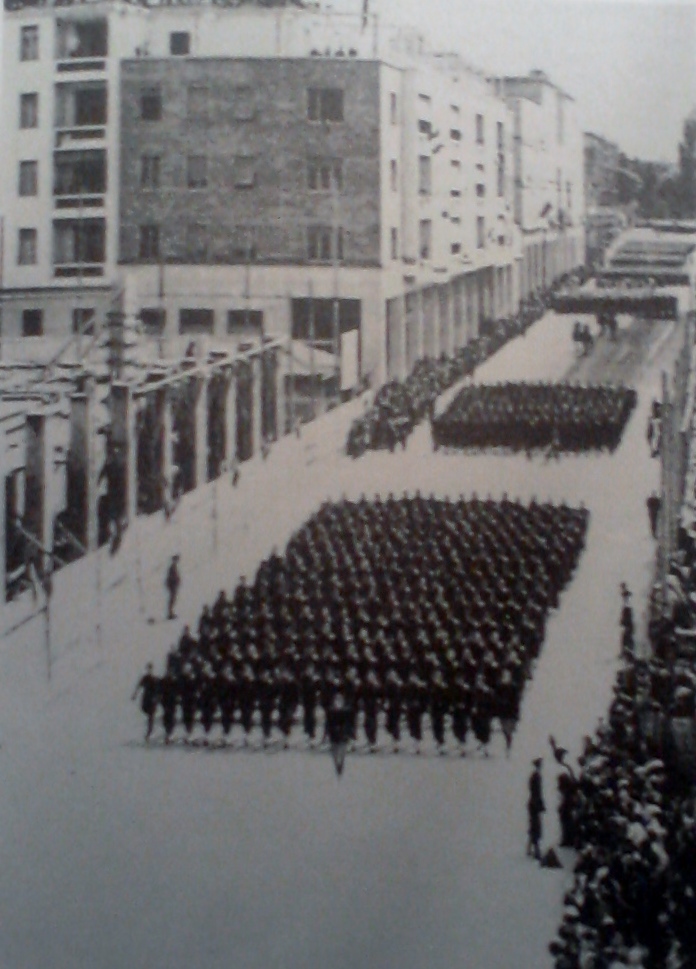
Furthermore a large industrial zone in Bolzano opened in 1935: it was followed by the immigration of many workers and their families from other parts of Italy (mainly from Veneto). An improvement of Bolzano's economy -the city doubled in population and size before WW2- was created by the newly developed industrial activities: video of 1939 Bolzano (https://www.youtube.com/watch?v=oWN2oILRN3s). A huge steel mill, an aluminum mill and a magnesium mill were inaugurated in the late 1930s; also the airport (founded in October 1926 with "Regio Decreto # 1994" and named "Sabelli") and a new improved railway station were created in those years. Eleven huge industrial buildings were created (from Falck metallurgies to Lancia cars) that gave work to hundreds of new "Bolzanini". In the early 1940s was completed the "Casa littoria", a masterpiece of rationalist style; also a new modern industrial quarter was completed with large alleys & the worldwide famous "Monumento alla Vittoria" (Monument to Victory) in the former "Gries" area.
Italian troops marching in a new quarter of Bolzano in the 1930s
An agreement in 1938 between Hitler and Mussolini provided for extensive forced migration of the German-speaking population to Germany or to other parts of Italy.
Between 1939 and 1942 nearly 75,000 German speaking inhabitants of the Alto Adige (mostly from the Val Venosta and the main cities) moved to live in the Third Reich Germany (we have to remember that in the 1921 Italian census there were 190,855 German speaking inhabitants -read https://books.google.com/books?id=rwFJu_3NtXAC&pg=PA64&dq=censimento+austriaco+1910&hl=it&source=gbs_toc_r&cad=3#v=onepage&q=censimento%20austriaco%201910&f=false- in the Italian Alto Adige). And this fact means that more than 120,000 of them never moved from Alto Adige.
However, this program was extremely unpopular between the German speaking population and soon collapsed since 1943, when Hitler occupied Bolzano in September of that year beginning a process of vengeful expulsion of the Italians.
Following an agreement (1946) between the Italian and Austrian governments, the republican constitution of Italy (1947) granted the region considerable autonomy. Both German and Italian were made official languages, and German schools were permitted in Bolzano province. However, the German-speaking population in the province (called Südtirol, or South Tyrol, by the Germans) continued to demand greater autonomy. They received the backing of Austria, which charged that the German-speaking population in Bolzano had not been given the autonomy envisaged in the 1946 Austro-Italian agreement.
Serious tension developed between the two countries. In 1960 the Bolzano problem was debated, at Austria's request, at the United Nations, on whose recommendation Italy and Austria entered into direct negotiations. Their efforts were partially vitiated by acts of terror committed in the region in 1961. It was only in 1971 that a treaty was signed and ratified; this agreement stipulated that disputes in Bolzano would be submitted for settlement to the International Court of Justice in The Hague, that the province would receive increased legislative and administrative autonomy from Italy, and that Austria would not interfere in Bolzano's internal affairs. The region was granted increased autonomy in 1972.
----------------------------------------------------------------------------------------------------------
Coat of Arms of the Italian "Provincia di Bolzano", created in 1927

A monument-sign of Italian Bolzano
The Monument to Victory ("Monumento alla Vittoria") is one of the most controversial signs of the ‘Italianisation’ of the province of Alto Adige. Built by Marcello Piacentini on the orders of Mussolini between 1926 and 1928, during the first wave of colonisation of the area, the monument immediately became the symbolic and ideological centre of the Italian town created west of the river Talvera, opposite the old ‘Austrian’ historical centre.
The project was proposed as a "tribute" for the Italian martyrs of World War One. In reality it was a triumphal arch built in the area of a pre-existing Austrian monument, that imposed a Fascist iconography and a nationalistic rhetoric on a nearly (until then) exclusively German speaking population. It was an instrument of remembrance to the historical fact that Bolzano was populated initially by romance population since Roman times and until the late Middle ages.
This symbolism and a pervasive iconography of ‘victory’ over Austria culminated in a Latin inscription that pinpoints the borders of the Italian nation: ‘Hic patriae fines signa hinc ceteros excolimus lingua legibus artibus’ (here are the borders of the Fatherland, fix the sign. From here we taught the languages, the laws and the arts’).

It reified a series of narratives dear to Fascist rhetoric: the link with Imperial Rome, the link with World War One, the cult of the veterans and their victory through the Italian irredentism's ‘Redemption’ of the Alto Adige. For example, German critics pinpoint that the statue of ‘Jesus the Redeemer’ by Libero Andreotti – a reiteration of the by then established iconography of the soldier/martyr – is strategically positioned to the East, directly facing the Alto Adige/South-Tyrolean German speaking part of town. Busts of the “martyrs” of Italian irredentism Cesare Battisti, Damiano Chiesa, and Fabio Filzi, accompanied by Andreotti’s resurgent Christ, sit atop the main platform.
The Monument to Victory is in this sense not only a mythical construction in the Barthesian sense, a further sign that carries an ideological meaning beyond the literal: it is an instrument of cohesion for the newly arrived Italian speaking population. Like most myths, this extremely simplified and confrontational reduction is easily transmitted and disseminated.
The monument, fenced and closed to the public in 1978 for fear of vandalism related to the pro-Austrian terrorism, with the exception of a restoration in 1993, remained isolated for decades. Actually is being restored and promoted as an historical monument of Italian Bolzano (read for further information and photos: http://jeffreyschnapp.com/2014/07/23/about-a-monument-and-a-ring/).
-------------------------------------------------------------------------------------
Changes in Bolzano's language speaking population (approximate percentages):
YEAR -----ROMANCE-------GERMAN
600...……..100%...……………….0%
800...…….3/4%...……………….1/4%
1000...…...2/3%...……………….1/3%
1200....… ~1/2%...………….....~1/2%
1800...…….51%...………………..49%
1860...…….23%...………………..77%
1900...…...12%...………………...88%
1917...…...~5%...……………….~95%
1941...…...~80%...……………...~20%
1971...…....78%...………………...22%
2011...…....75%...………………...25%
--------------------------------------------------------------------------------------
As can be read in the above data, the presence of huge romance populations (initially Ladins, then Italians) in Bolzano is continuous since Roman times. Only in the XIX century & initial XX century (precisely in the nearly one hundred years from the Congress of Vienna until 1918) the German community was the huge majority: after WW1 the Italian "Bolzanini" -as they are called in Italian language- were again the large majority (when the city nearly doubled the population thanks to immigration from Italy's other regions and to creation of new industrial quarters).