Sunday, April 7, 2019

FIRST ITALIAN JETS

There it is an interesting discussion in academic circles about the first "jet" airplanes created in the world during the XX century. Usually the Germans are judged as the first to create such a modern aircraft, but some researchers think that the Italians could have been the first. Here it is what I have found about:
The Italians created the "Campini Caproni" in the 1930s (read for further details: http://tanks45.tripod.com/Jets45/Histories/CC-2/CC-2.htm).
This creative study was the first about an airplane moved by jet propulsion. I have written in my controversial April 2017 issue (if interested in the full article, please read: https://researchomnia.blogspot.com/2017/04/the-truth-about-ufo-in-1933-italy.html) that <...we have to remember that Italian engineer Secondo Campini submitted a report on the potential of jet propulsion to the Regia Aeronautica, and demonstrated a jet-powered boat in Venice: in 1934, the Regia Aeronautica granted approval for the development of a jet aircraft to demonstrate the principle used by Campini and made a contract with him in order to receive 2 aircrafts with "propulsione a reazione" (jet propulsion) in the second half of the 1930s... >.

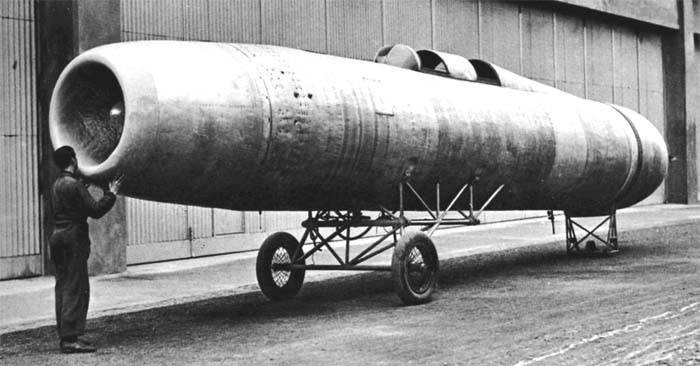
The Caproni Campini CC2 in an Italian Museum. It is the first jet airplane in History to have done a "regular" flight, because the German Heinkel He 176 & 178 were experimental jet-prototypes that did "tentative" flights of only a few minutes
Outside of Italy, the first studies for a turbojet engine date back to the 1920s thanks to the Englishman Frank Whittle and yet until the end of the 1930s no jet aircraft were built. The Italian Campini Caproni was started to be created in 1935.
Indeed on December 17, 1935, engineer Secondo Campini drafted a US patent (No. 2024274) for the construction of a jet plane, which unfortunately was not built. The deadline for the delivery of the prototypes was established on December 31, 1936, but due to some technical difficulties and mainly to increasing costs, the Undersecretary of the Italian Aeronautical government Department -General Valle- was asked to postpone to later dates.
Engineer Secondo Campini
However a fuselage was then built for static tests, preserved today at an Italian Museum, and the engine, which gave a fixed point thrust of about 700 kg and two prototypes with military serial number MM487 and MM488 called "Campini-Caproni CC2" (sometimes called "Campini Caproni N1") were then prepared. This delay allowed the Germans to "anticipate" the first flight of a jet aircraft!
So, in June 1939 the german "Heinkel He.176" rocket plane flew for a few minutes, followed in August of the same year by the Heinkel 178 driven by a jet engine with centrifugal compressor, while only in August 1940 the Campini Caproni flew.
This unique aircraft is therefore one of the first in the world to have flown with jet propulsion. The aircraft, with hybrid propulsion, was defined as a "motor-reactor" because it was driven by a reciprocating engine that operated an axial compressor and by an afterburner through which the air flow, previously accelerated, was mixed with fuel and then burned causing propulsion jet.
Certainly far from a traditional jet engine - composed of compressor, combustion chambers, turbine and exhaust nozzle - this aircraft must be counted among those that contributed to the subsequent development of aviation technology.


Indeed Campini's engine used an ordinary piston engine to compress air which was then mixed with fuel and ignited.
Modern jets are based on the turbojet principle, but Campini's jet was nevertheless a true jet, since it was the reactive force of the burning exhaust gases that pushed the plane along.
However the Italian aircraft designer Luigi Stipa (1900-1992) contended that his "Stipa-Caproni" experimental aircraft, a ducted-fan design of 1932, was the first aircraft to employ what he called an "intubed propeller" -- essentially the motorjet principle -- and that he therefore deserves the credit for the invention of the jet engine. The Caproni-Campini N.1 (or CC2) did employ many of the principles first tested in the Stipa-Caproni aircraft, albeit in a more advanced form.
Caproni built the Stipa aircraft, as per the Regia Aeronautica requirements, at their plant near Milan in 1932. The unusual design caused a number of sceptical comments and the original design intention of increasing the efficiency of the propeller by reducing the losses was generally misunderstood. The wide fuselage was practically a tunnel with a profile similar to the wings. And could have been considered to be a "circular wing". A 120 HP Gipsy III engine was mounted inside a tapered duct driving a two-blade tractor propeller, in effect utilising the Bernoulli Principle related to fluids moving in a venture duct. Stipa idea was, in fact, an important step towards the achievement of jet propulsion.

Princetown University Press published "High Speed Aerodynamics and Jet Propulsion" in 1959 and in Vol. XII stated: "The Stipa Aero plane built by Caproni in 1932 should be classified as a Jet Aircraft. 'The Stipe Aero plane can be considered as a predecessor of the Jet Aircraft of today". In this video can be seen the "tube-engine" typical of jets:https://www.youtube.com/watch?v=xYqr2h_xQRk
The Regia Aeronautica however, decided that the advantages of the duct fan were not sufficient to continue with the development and the project was dropped. Stipa was called to France in 1938 to develop his "Stipa 203" fighter, but the start of WW II ended this project. He patented the principle of the "pulsating jet engine" in 1938 in Italy, Germany and the United States and remained convinced to his death in 1992 that the Germans used his patent to develop the famous "V-1" engine (bombing London).
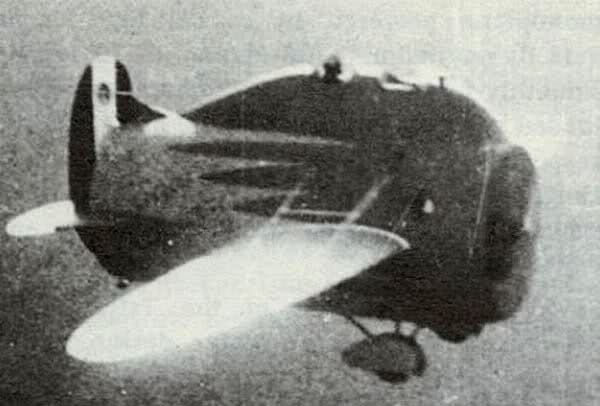
The "unusual design" of the Caproni-Stipa in 1932 (read: http://www.seqair.com/Hangar/Zuccoli/Legends/StipaNotes.pdf)
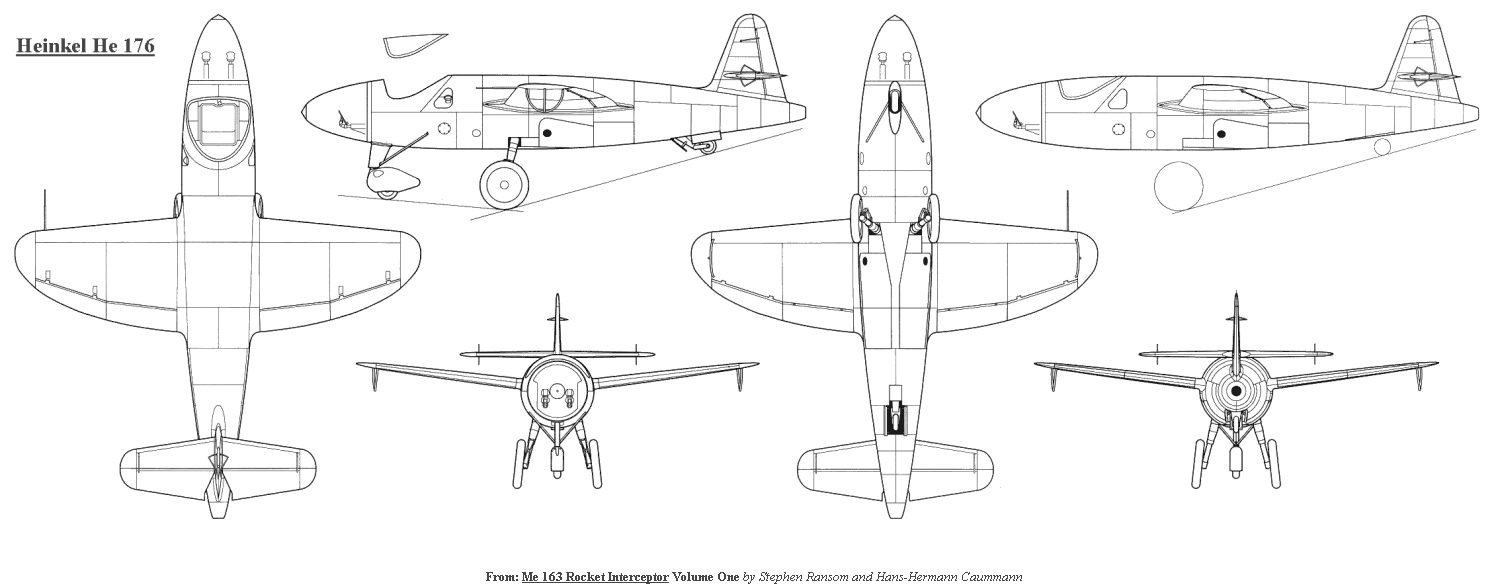
We have to pinpoint that the story of the Heinkel He 176 rocket powered aircraft has been clouded in mystery and incorrect information for many years. Only in the last few years have some of the real facts emerged. Although there had been a few german rocket powered planes earlier (Espenlaub's E 7 and the Opel-Sander Rak-1), these both used solid fuel rockets.The He 176 was to be the first aircraft in history to fly using only liquid-fueled rocket power. A proposal was first put forth in Berlin in May 1935 by Major Wolfram von Richthofen to develop a rocket-powered interceptor for the use against high flying bombers. This led to the Heinkel He 176 prototype, and eventually the Messerschmitt Me 163, the world's first rocket-powered combat interceptor.Design work was begun in late 1936, with detailed engineering drawings being completed around July 1937. Construction of the prototype began at the same time.
The first official flight of the Heinkel He 176 V1 was on June 20, 1939 flown by Erich Warsitz. On the next day, June 21, the He 176 was demonstrated in front of some german leaders (Ernst Udet, Erhard Milch). Udet was not impressed, and prohibited further tests due to the inherent dangers of rocket flight. This ban was twice lifted and twice issued again until July 3, 1939, when another demonstration was arranged at Roggentin for Adolf Hitler and more of the Third Reich leadership. An official order was issued on September 12, 1939 terminating any further work on the He 176 project.
On 27 August 1939 the Heinkel He 178 became the first aircraft to take to the skies powered entirely by a turbojet engine: the He 178 first took to the air on 24 August 1939, when it left the runway for a short time, but its first proper maiden flight came on three days later. This flight was only a partial success, as the engine was badly damaged by a bird strike soon after take-off, but the test pilot, Erich Warsitz, still had time to make a circuit of the airfield and land safely without power. The second test flight didn't come until 1 November 1939. The engine had been modified to produce the HeS 6, which produced 1,300lb of thrust, giving the aircraft a top speed of 373mph. This second flight was observed by a number of senior figures in the Luftwaffe and German Air Ministry, including Udet, Milch and Lucht, but despite the aircraft's obvious high speed there was very little official interest until the end of the year. The German Air Ministry had its own jet engine development section, and wasn't interested in private developments, at least until the then head of the department moved on.
His successor was more encouraging, but even then work on the single engined He 178 V1 soon came to a halt. Heinkel produced a design for the model V2, which would have had a retractable undercarriage and new wings, but this aircraft probably never flew. Instead work moved onto twin engined aircraft, with the Heinkel He 280 and finally with the famous Messerschmitt Me 262.
The first flight of the He 178 came almost exactly one year ahead of that of the Italian jet aircraft, the Caproni-Campini CC2, and twenty months ahead of that of the second turbojet aircraft, the British Gloster E.28/29, which took to the air on 15 May 1941.
Finally we have to pinpoint that the further development of the Italian jet design was shown in the futuristic (for those years) shape of the controversial "Reggiane Re2007" (read https://aviateur01.skyrock.com/485122705-Les-avions-a-reaction-le-Reggiane-Re-2007.html ).Even if initially studied as a pre-project in 1942 (after the Caproni Campini CC2's flights), this Reggiane "caccia" (jet-fighter) was well ahead of his time. Secondo Campini, having formed a partnership with another Italian aircraft company (Reggiane) and aircraft designer Roberto Longhi, commenced work on an entirely new design: the Reggiane Re2007. This was a significant departure from the Campini Caproni N.1, including the successive decision to abandon the indigenous Italian engine it used in favour of a German-provided counterpart: the Jumo 004 reactor. At the moment of Italian armistice in September 1943, this project of engineer Roberto Longhi was ready at 70%, according to historian Piero Baroni (read: https://books.google.com/books?id=N3jPv-yONNoC&pg=PA263&lpg=PA263&dq=reggiane+re.2007&source=bl&ots=ZlwbV7SV2j&sig=ACfU3U00axqn8INfTH9zDoVP17Wh0m1Xew&hl=en&sa=X&ved=2ahUKEwjt6OrqpLnhAhVD94MKHRulBeA4PBDoATAGegQICRAB#v=onepage&q=reggiane%20re.2007&f=false).
This Reggiane project began to be built in Reggio Emilia (Emilia-Romagna) in October 1943, while the search for materials soon after. The whole project was based on the essential contribution of the Germans: the Junkers JUMO 004 reactor was necessary to propel the plane. But the project did not progress until January 1944, because of the lack of information on the performance and structure of the machine (read http://www.reggiane.info/lang1/description-7.html). The project was never completed because of the difficult relations between German and Italian authorities: the two Jumo 004 reactors requested were sent to Italy, but too late to adapt to the plane that had already been built, before the German-Italian forces did surrender in spring 1945. That said, the plane could have constituted a formidable opponent for the Allied propeller fighters: flying at more than 1000 km/h, the plane could beat all his opponents in speed; indeed the best Allied fighters did not exceed 700 km/h. By being well armed, with four 20mm cannons in his muzzle, he could have been a formidable interceptor for the huge waves of Allied bombers flying in the skies of northern Italy: difficult to strafe, from a bomber it would have been even very hard to defend from this Reggiane Re2007 effectively. The defense of such devices was ensured at the time by machine gunners shooting at the vision of the aircraft, but it was difficult for a human being to have enough reflexes to shoot on a plane flying at nearly 1000 km/h.

Models of the "Reggiane Re2007" and the "Caproni Campini CC2"
However there are some experts who argue that this jet was a fake invention. They complain that no manager of the Reggiane has ever had knowledge of this project, but other experts argue that it was a secret project and only a few were informed about this Reggiane Re2007. Additionally historians like Baroni argue that the two Jumo 004 reactors were sent without doubts to Italy for an experimental fast aircraft (he wrote: "for what reasons if the jet was fake?"). The drawings were lost during the Reggiane factory bombing by Allies, but the pictures & drawings -made after WW2- are indicative of a modern jet.

Anyway, what more strikes all of us is the similar shape with some Russian "Migs" of the late 1940s (like the Mig9 with a nearly identical tail, built in 1946; see https://www.smartage.pl/mig-9-pierwszy-radziecki-mysliwiec-o-napedzie-odrzutowym/)........and Baroni surmises that probably the remaining project documents were stolen, after the factory destruction, by some members of the Italian communist party (very strong in this region) and sent to the Soviet Union!

Conclusion
The first jets were Italian? The answer -in my opinion- is yes and no.
No, because undoubtedly the first jet flight was done as a tentative experiment by the German Heinkel He 176 in June 1939, even if lasted only a few minutes. Yes, because the first "real" flight (without huge experimental "risks") was done by the Italian Campini Caproni CC2 in August 1940.....and this jet did also a first "commercial" flight when later worked as a mail transport between the two main Italian cities (Rome and Milan).
Additionally we must remember that the Campini Caproni CC2 was a complete "operative" aircraft authorized officially to operate by the Italian government and that had a not-flying prototype assembled in 1936 (there it is still the original first "experimental" fuselage in an Italian Museum: http://www.airwar.ru/image/idop/xplane/cc2/cc2-1.jpg). While the German Heinkel He 176 was a prototype that was started to be designed & created one year later, in 1937: it was quickly used in a risky flight in June 1939, rejected by the German authorities after doing only four dangerous minutes take off from the ground.


The Caproni-Stipa first flight in 1932
Furthermore we have to remember that the first airplane to fly using the "ejection air principle" (the word "jet" comes from "eJEcTion") was the Stipa Caproni in 1932....so, as the Princeton University Press stated, "The Stipa Aero plane built by Caproni in 1932 should be classified as a Jet Aircraft.The Stipe Aero plane can be considered as a predecessor of the Jet Aircraft of today". In other words, if classified as jet aircraft that means that it was the first jet aircraft! However, I personally think that this opinion is "a bit excessive". But something can be taken for true.

Thursday, March 7, 2019

THEORETICAL ITALIAN PROVINCES IN GREECE'S AEGEAN ISLANDS/PROGETTATE PROVINCE ITALIANE NELL'EGEO

Few scholars have thoroughly analyzed the Italian occupation of the Sporades and Cyclades islands in the Second World War.
After all, Italy - with the "suffered" victory over Greece - in 1941 obtained control of most of mainland Greece (Epirus, Thessaly, Attica and Peloponnese), in addition to the Ionian islands with Corfu, Zante and Kefalonia, Cyclades, and the southern Sporades with Samos, Furni and Icaria and a territory at the eastern tip of Crete.

HISTORICAL SITUATION IN 1941-1943

The territorial division of Greece was fundamentally decided by the Germans and communicated to the Italians as a 'fait accompli' ("the Germans communicated a boundary to us, we could not but acknowledge" Mussolini himself recognized), as was the Athens settlement of the Tsolakoglu government.
Italy's plans for the annexation of various Greek territories (the Ionian Islands, the Cyclades and the Sporades to be added to the Dodecanese, the Epirus to be annexed to Albania) were postponed by the Germans themselves at the time of the final victory in the war.

The military occupation of the Greek regions, entrusted to the XI Armata, represented a heavy commitment for Italy in terms of men and resources employed, even if very uneven in terms of the armed opposition encountered: the Greek Resistance was very active in the northern regions, Epirus and Thessaly, while in the Peloponnese and in the islands it was never particularly strong, leaving to the Italian units there more police-related tasks than violent repression.
However, in spite of the hostility shown at the time of surrender in April 1941, with the passage of time the attitude of the Greek population became more benevolent towards the Italians, whose behavior in principle had little to do with the methods of violent occupation of the Germans. After all, it is enough to see a famous film about the Italian occupation of Kefalonia - "The mandolin of Captain Corelli" - to understand how the Greek populations showed themselves "benevolent" towards the Italian occupants (and vice versa).

CYCLADES AND ITALIAN SPORADES: "PROVINCE OF THE CYCLADES" AND "PROVINCE OF SAMO"
The irredentism of Fascism wanted to include in its project of enlargement of imperial Italy - going back to the maritime republics of Venice and Genoa - even the islands of the Aegean between the Dodecanese and the Ionian islands. In this way Mussolini wanted to create (after his victory in WW2, as he hoped) a historical-geographical continuity of Italian islands that from Corfu '(in front of Albania) arrived until Castellorizzo (in front of southern Anatolia).
For this purpose - after the occupation of almost all of Greece in April 1941 - proceeded to implement a forced "Italianization" of the local populations of these Greek islands together with the administrative creation of "Italian Provinces" (such as the Ionian provinces, p[us the Cyclades and Samo provinces). For Corfu 'Mussolini went back to the "Italian Corfioti", immediately detaching the Ionian islands from Greece (at least administratively), while for the Aegean islands he limited himself to wait until the end of the war in order of not going against the will of Hitler. The Cyclades islands and some of the Sporades islands were militarily occupied in the spring of 1941 and were immediately incorporated into the "Italian islands of the Aegean". Ettore Bastico had the title of Civil and Military Governor of the Italian Isles of the Aegean, just like the previous governor of the "Islands of the Dodecanese" Cesare Maria De Vecchi of Val Cismon. ETTORE BASTICO was governor from 10/12/1940 to 1/7/1941. Admiral Inigo Campioni, later shot by the Germans, succeeded him from 15/7/1941 to 11/9/1943. Consul General Igino Ugo Faralli was its last governor, from 11/9/1943 to 18/9/1943. Indeed Ettore Bastico was an artillery general. Thanks to his noble conduct, he earned the esteem and affection of the civilians and the military in the Italian Aegean islands, taking measures to improve their lives. He occupied Castellorizzo, the Cyclades, Samos and Icaria as well as the east part of Crete. He was suddenly transferred, perhaps as a reward, to the African front (Fanizza Rugerro: "De Vecchi, Bastico, Campioni, the last governors of the Aegean." Vasbonesi, Forlì, 1947). INIGO CAMPIONI followed Bastico. He tried to impose a process of "Italianization" in these islands, but with only minor results. ITALIAN CYCLADES
CYCLADES: The Cyclades were administered as a future "Italian province": the "CIVIL COMMISSIONER FOR THE PROVINCE OF CYCLADES" was established on the island of Syra (also called "Siro" in Italian). Ermopoli, the administrative capital of the Cyclades islands, was and is the capital of the island. In Siro, the Italian authorities created a police station that promoted - among other things - food aid to the civilian populations of the Cyclades: in this way the terrible famine that the Greek population in 1042 did only a few thousand victims in the Cyclades (as were relatively few in all the other Greek islands that, in Mussolini's projects, should have been annexed to Italy at the end of the "victorious" world war). Only a few minor islands suffered a great deal initially - but they were immediately rescued by the Italian government, unlike the huge disaster (with many deaths: over 300,000 between 1941 and 1944!) That occurred in the Greek mainland. If interested, read on page 144-149 the book "Famine and Death in Occupied Greece, 1941-1944", written by Violetta Hionidou
The Italian occupation began on the islands in the Aegean on May 6, 1941. The island of Siro, with the capital of the Cyclades, was occupied after only five days. The invasion force was formed by units of the "Regina" Division, which were transported by destroyers Crispi and Sella (departing from the nearby Dodecanese). The following 10 July 1941 took over the "Cuneo" Division to the "Queen" units in the southern Cyclades and Sporades garrison. An air link between Rhodes and Siro guaranteed the postal service. In Italian Cycladic schools the study of the Italian language became compulsory.
Among the civilian population there was a substantial approval of the Italian presence only in the area of ​​the capital of Siro and in the island of Tino, where many boasted distant Venetian roots and were numerous Catholics for centuries - especially in the town "Ano Syros", founded in 1200 by the Venetians. Ano Syros, the Catholic stronghold in Siro, supported the Italianization of the Cyclades even if moderately: this was assisted by the Italian authorities and did not suffer death from the famine that damaged the Greek population especially in February 1942. Many Catholic inhabitants of Ano Syros (and someone from Tino) were later imprisoned by the Greeks (Orthodox) with the charge of collaborationism in 1945. ITALIAN SPORADES SPORADES: The same happened with the southern Sporades islands occupied by the Italians. In fact the three main islands of the Italian Sporades (Samo, Icaria and Fourni) were administered with the creation of the "CIVIL COMMISSIONER FOR THE PROVINCE OF SAMO". Also in this case it was expected that at the conclusion of the war these islands were to unite to the Kingdom of Italy in the newly created "Province of Samo".
On May 9, 1941 the island of Samo, the main island of the southern Italian Sporades, was occupied by the "Regina" Division and Vathy (near the historic town of Samo) declared its administrative capital. In the following September, the "Cuneo" Division took over the "Regina". In Samo a first telegraph service was set up in September 1941. A forced attempt at Italianisation was also begun here, especially in schools.
The attempt by the wife of the political commissioner Bianco Tizianotti to organize social events in Samo and Icaria, failed miserably. The antipathy of the population was such that very few local Greeks (less than a hundred in all) were accused of collaboration after the end of the war (in 1945).
At Samos from the end of 1942 there was a reduced action of Greek partisans against the Italian troops, unlike the other Cycladic islands and Sporades where until September 1943 - when Italy surrendered to the Allies - there was no military or paramilitary activity.
In fact, at the time of the Badoglio armistice, in September 1943, on the island of Samos, there were two groups of resistants of about 300 men. These groups, which politically were of the extreme left, had been organized in October 1942. The ELAS (Greek Resistance Army) of Samos received the armament and financial help of the British service SOE, located in Asia Minor, with whom it had been in permanent contact since the end of 1942. The essential contribution of this resistance was the harassment of the Italian authorities and the main purpose was a general uprising. The plan failed because the anti-fascist committee, waiting for the maneuvers of Badoglio who took over from Mussolini, did not dare to move openly. Restless, the Italian authorities of Rhodes sent two battalions of Italian fascist 'Black Shirts' to observe the possible maneuvers of these resisters.... and all remained quiet (Nicola Tsagas: "Icaria under the Italian occupation, 1941 - 1943").


Map of the theoretical provinces of Italy in Greece's Aegean sea/Mappa delle "progettate" Province italiane in Grecia/

PROVINCIA DELLE CICLADI:


PROVINCIA DI SAMO: